It is common to look after the skin on your face carefully yet notice that your neck seems to be ageing differently. Horizontal lines may deepen, the skin can become thinner or crepey, and the transition between the jawline and neck may gradually lose definition.
This happens because skin ageing does not progress uniformly across the face and neck. Collagen loss, repeated movement, sun exposure and changes in the underlying muscles and tissues all play a part, while many people have also spent years applying SPF and active skincare to their face but stopping at the jawline.
At FACEMED in Billericay, Essex, we often see that what patients describe as an “ageing neck” is actually a combination of changes. Understanding whether the main issue is skin quality, lines, muscle activity or laxity helps determine which approach, if any, is likely to be useful.
Why Can Your Neck Look Older Than Your Face?
As we age, collagen and elastin production declines, making the skin less firm and resilient and contributing to lines, crepiness and skin laxity.
The neck is also constantly moving. Turning your head, looking down and extending the neck repeatedly folds the skin along similar points, which can gradually make horizontal creases more established. UV exposure can accelerate these changes by contributing to collagen breakdown, pigmentation and uneven texture.
Skin is only part of the picture. The platysma, a broad muscle extending across the neck into the lower face, can become more visible with age, while changes beneath the chin and around the jawline can reduce definition. This is why describing the concern simply as “neck wrinkles” does not necessarily explain what is causing it.
What Are the Different Signs of Neck Ageing?
Neck ageing can include:
- horizontal lines and fine creases
- thin or crepey skin
- reduced firmness and elasticity
- vertical neck bands
- loose or sagging skin
- reduced definition beneath the chin and jawline
These changes often overlap, although one may be much more prominent. Someone with horizontal lines but otherwise firm skin has a very different ageing pattern from someone with significant laxity beneath the jaw, so identifying the structure responsible for the change is important before considering treatment.
Why Do Horizontal Lines Develop Across the Neck?
Horizontal neck lines can appear well before other signs of ageing because the skin repeatedly folds during everyday movement. As collagen, elasticity and hydration decline, these creases can become more noticeable even when the neck is relaxed.
They should not automatically be confused with loose skin. Prominent horizontal lines can occur without significant laxity, just as sagging can develop without particularly deep creases. FACEMED’s guide to fine lines and wrinkles explains more about the processes involved in line formation.
Does Crepey Neck Skin Mean the Skin Is Loose?
Crepey skin and loose skin can occur together, but they are not the same thing. Crepiness generally describes skin quality, where the surface appears thin, finely wrinkled, dehydrated or less resilient, whereas laxity refers to a loss of firmness that allows tissue to sag.
This distinction affects treatment choice. For milder cases, where the main changes are hydration, texture or early loss of elasticity, we would usually look at improving skin quality before considering treatments intended to tighten or reposition tissue.
Can Profhilo Help Ageing Skin on the Neck?
Profhilo may be considered when dehydration, fine creasing and declining elasticity are contributing to the appearance of the neck.
It contains hyaluronic acid, a substance naturally present within the body that has an important role in hydration. Unlike conventional dermal filler, Profhilo is not primarily intended to build volume or reshape a feature. It distributes through the treated tissue to support hydration and skin remodelling, and FACEMED uses it on areas including the face, neck and chest.
It is therefore more relevant to changes in skin quality than significant sagging. Where loose tissue is the dominant concern, an approach that works more directly on laxity may be appropriate.
How Does Morpheus8 Work on the Neck?
Morpheus8 combines microneedling with radiofrequency energy delivered at controlled depths within the tissue. This creates a controlled repair response that stimulates collagen and elastin production.
For the neck, it may be considered where texture changes, fine lines, reduced firmness and early laxity occur together. Rather than simply improving hydration, the aim is to remodel the tissue gradually.
FACEMED treats both the face and neck with Morpheus8 and can combine it with PRP to support tissue repair and regeneration. Combining treatments can be useful when they address different aspects of the same concern, but there should always be a clear reason for including each part of the plan.
Why Do Vertical Bands Appear on the Neck?
Vertical neck bands are often influenced by the platysma muscle rather than the skin alone. As its activity becomes more visible, vertical cords can appear, particularly when the neck is tensed.
Where muscle activity is the main contributor, improving hydration or texture alone will not address the cause. FACEMED’s Nefertiti Lift uses carefully placed Botulinum Toxin Type A injections along the lower jawline and platysma to reduce selected muscle activity.
This can soften visible bands and reduce downward muscular pull around the lower face and jawline, but it does not remove loose skin. Its role is therefore quite different from a treatment designed to tighten or reposition tissue.
What If Loose Neck Skin Is the Main Concern?
Where laxity is more established, improving hydration or superficial skin quality alone may not provide enough change.
FaceTite uses radiofrequency-assisted lipolysis technology to deliver controlled energy beneath the skin, encouraging tissue contraction and collagen production. It can also address small pockets of unwanted fat where these contribute to the contour, and FACEMED uses the treatment across areas including the lower face, jawline, chin and neck.
This makes FaceTite more relevant where laxity or loss of definition has become a greater part of the concern. The degree of intervention should still reflect the severity of the change, rather than choosing a deeper treatment simply because it is available.
Can PDO Threads Lift an Ageing Neck?
PDO thread lifting may be considered for selected patients with limited skin sagging. Biodegradable polydioxanone threads are positioned within the tissue to provide support and repositioning while also stimulating a healing response associated with collagen production.
FACEMED uses threads suitable for face and neck lifting and combines its thread lift procedures with PRP. Patient selection is particularly important because there is a limit to how much loose tissue threads can reposition, and non-surgical treatment cannot reproduce the correction possible with surgery where laxity is more advanced.
How Do You Know Which Neck Treatment Is Most Appropriate?
Treatment choice should be guided by what is causing the visible change, rather than starting with a particular procedure. Fine lines and declining skin quality require a different approach from platysmal bands, loose skin or reduced jawline definition, and several of these factors may be present at once.
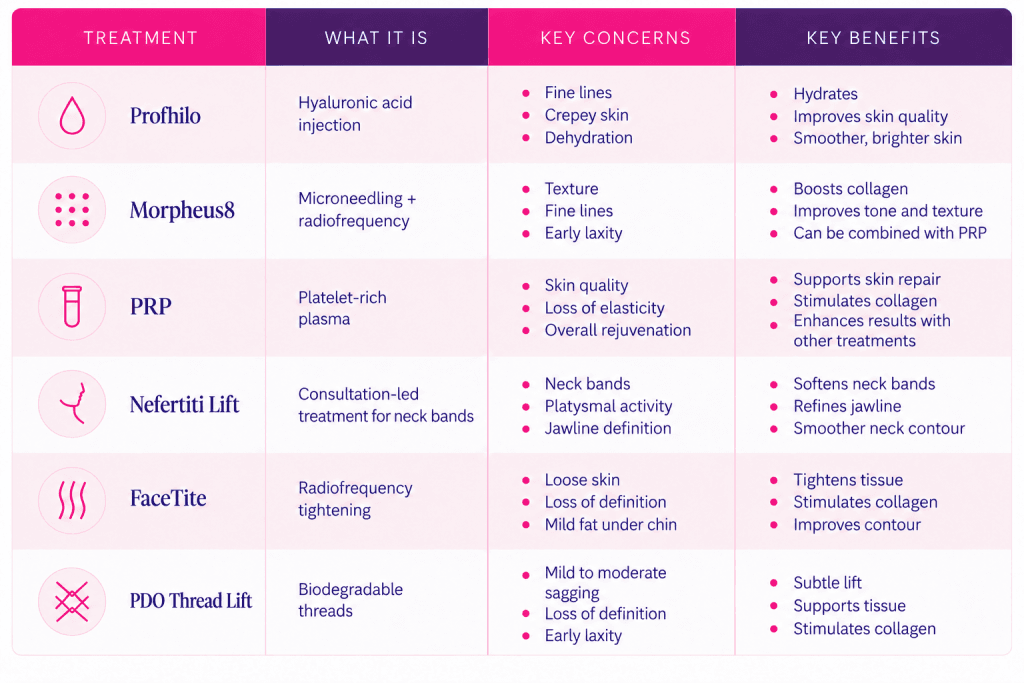
Where concerns overlap, treatment can sometimes be combined or staged. The table below gives an at-a-glance comparison of the treatments discussed and the changes they are designed to address.
FAQs About Neck Skin Ageing
At what age should I start treating my neck?
There is no set age. Treatment should respond to a specific concern rather than a birthday, as horizontal lines, skin quality and laxity can develop at very different stages from one person to another.
Can weight loss make neck ageing more noticeable?
Yes. Losing volume around the lower face and neck can make existing laxity more apparent, particularly where skin elasticity has already declined. Assessment can help distinguish between loose skin, altered contour and other contributing factors.
Why does my neck look worse when I look down?
Looking down naturally folds and compresses the skin, making lines and laxity more visible. For this reason, the neck should be assessed both at rest and during movement.
Does neck treatment need to include the décolletage?
Not necessarily. Although both areas can develop sun-related and age-related changes, their skin quality may differ and each should be assessed individually.
Can aesthetic treatment completely remove neck wrinkles?
No treatment can prevent normal movement or stop the ageing process. The aim is to improve the specific features causing concern, such as skin quality, lines, laxity or visible muscle bands, rather than create completely line-free skin.
Understanding What Is Ageing Before Treating It
Changes in the neck can come from the skin, repeated movement, the platysma muscle or loss of definition around the jawline and underlying tissues, often with more than one factor involved. Identifying the main cause helps determine whether treatment is appropriate and which approach is most likely to address it.
At FACEMED Medical & Dental Centre in Billericay, Essex, the neck can be assessed alongside the lower face and jawline so that any treatment plan reflects the anatomy and condition of the tissue rather than treating “neck ageing” as a single concern.
If you would like to understand what may be contributing to changes in your neck, you can request a consultation with FACEMED. FACEMED welcomes patients from Billericay, Brentwood, Chelmsford, Basildon, Wickford, Shenfield, Ingatestone and surrounding areas of Essex.