Hair thinning is a common concern at FACEMED, affecting both men and women at various stages of life. Whether it is a widening parting, increased shedding, reduced volume or early recession, many patients are looking for treatments that support healthier hair growth naturally rather than simply disguising the problem.
The good news is that advances in regenerative medicine have created exciting new options for hair restoration. Two treatments attracting significant attention are PRP (Platelet-Rich Plasma) and CROMA PhilArt Hair Polynucleotides.
Both are designed to support healthier, stronger hair, but they work in very different ways. PRP uses concentrated growth factors derived from your own blood to stimulate hair follicles, while PhilArt Hair Polynucleotides focus on improving scalp health and supporting cellular regeneration around the follicle.
Understanding these differences is often the key to choosing the most appropriate treatment plan for your hair loss concerns and long-term goals.
What Causes Hair Thinning and Hair Loss?
Before comparing treatments, it is important to understand what may be contributing to hair loss in the first place.
Hair growth occurs in cycles. Each hair follicle moves through phases of active growth, transition and rest. When this cycle becomes disrupted, hair can become thinner, weaker and less dense over time.
Common causes include:
- Genetics
- Hormonal changes
- Ageing
- Stress
- Nutritional deficiencies
- Illness
- Inflammatory scalp conditions
- Post-pregnancy hair shedding
- Menopause
A common mistake patients make is assuming all hair loss is the same. In reality, treatment selection depends heavily on the underlying cause, the severity of thinning and the condition of the scalp itself. This is why a proper assessment is always the starting point.
What Is PRP for Hair Loss?
PRP is Platelet-Rich Plasma. The treatment uses a sample of the patient’s own blood. After the blood is collected, it is processed in a centrifuge to separate and concentrate the platelets. These platelets contain growth factors that play an important role in healing and tissue regeneration.
Once prepared, the concentrated plasma is injected into areas affected by hair thinning. The aim is to stimulate dormant follicles, improve blood supply to the scalp and encourage healthier hair growth.
PRP has been used in various areas of medicine for many years, including sports medicine and wound healing, before becoming increasingly popular within regenerative aesthetics.
How Does PRP Help Hair Growth?
Hair follicles are living structures that rely on a healthy blood supply and supportive cellular environment.
The growth factors contained within PRP may help by:
- Supporting follicle activity
- Encouraging cellular repair
- Improving circulation around the follicles
- Extending the active growth phase of hair
- Strengthening existing hairs
In practice, PRP is often most effective when follicles are still present but becoming weaker. Patients with early to moderate thinning frequently achieve the best outcomes because the treatment can support existing follicles before significant loss occurs.
What Are CROMA PhilArt Hair Polynucleotides?
CROMA PhilArt Hair is part of a newer generation of regenerative treatments known as polynucleotides. Rather than relying on growth factors obtained from the patient’s own blood, PhilArt Hair contains highly purified polynucleotides that are designed to support tissue repair and regeneration.
Polynucleotides work at a cellular level to create a healthier environment for hair follicles. Instead of directly stimulating growth through platelet-derived growth factors, they focus on improving scalp health, reducing oxidative stress and encouraging optimal cellular function.
This difference is one of the reasons many practitioners now view polynucleotides as an exciting addition to hair restoration treatment plans.
How Do Hair Polynucleotides Work?
The scalp is often overlooked when discussing hair loss. However, healthy follicles require healthy surrounding tissue.
Polynucleotides help improve the environment in which follicles function by:
- Supporting tissue regeneration
- Improving hydration within the scalp
- Reducing inflammation
- Enhancing cellular repair mechanisms
- Supporting microcirculation
At FACEMED, we often see patients whose scalp health has deteriorated due to age, hormonal changes or long-standing thinning. In these cases, creating a healthier scalp environment can be just as important as stimulating the follicles themselves.
Many patients also report improvements in hair texture, strength and overall quality alongside changes in density.
PRP vs CROMA PhilArt Hair Polynucleotides
Although both treatments fall within the category of regenerative medicine, their mechanisms are quite different.
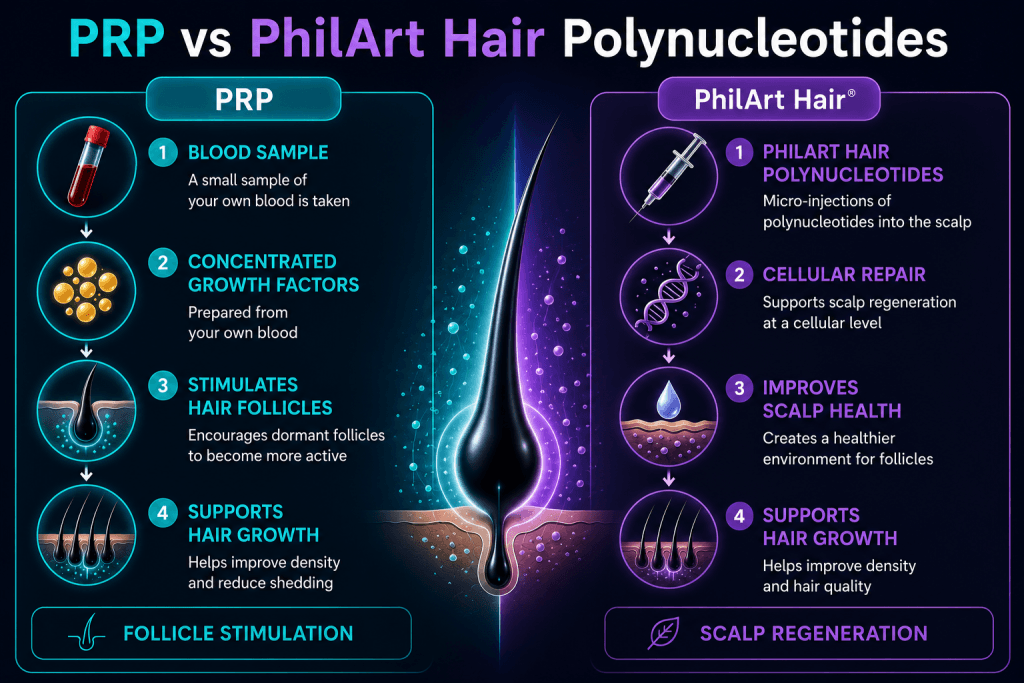
The right choice depends on individual factors including age, scalp condition, pattern of hair loss and treatment goals.
Can PRP and Hair Polynucleotides Be Combined?
Rather than viewing PRP and PhilArt Hair as competing treatments, many practitioners see them as complementary.
PRP provides growth factor stimulation. Polynucleotides support scalp regeneration and tissue quality. Combining both approaches may help address multiple aspects of hair loss simultaneously.
In more advanced cases, we would normally look at creating a longer-term programme rather than relying on a single treatment modality.
This may involve staged treatments that combine regenerative therapies alongside other medical recommendations where appropriate.
Are These Treatments Suitable for Men and Women?
Both PRP and CROMA PhilArt Hair Polynucleotides can be used in men and women experiencing hair thinning.
However, treatment planning often differs. Women frequently present with diffuse thinning across larger areas of the scalp, while men may have more localised recession or crown thinning. This is another reason why personalised assessment remains important.
The Importance of Early Intervention
One of the biggest misconceptions surrounding hair restoration is that treatment should only begin once hair loss becomes severe. In reality, earlier intervention often provides the greatest opportunity for improvement.
Once follicles have been inactive for a prolonged period, regeneration becomes significantly more challenging. Patients who seek advice when they first notice thinning often have more treatment options available to them and may achieve stronger outcomes over time.
FAQs
Is PRP better than CROMA PhilArt Hair Polynucleotides?
Neither treatment is universally better. PRP and Hair Polynucleotides work differently, and the most suitable option depends on your hair loss pattern, scalp condition and treatment goals.
How many sessions of PRP are usually needed?
Treatment protocols vary, but most patients require a course of treatments followed by maintenance sessions. Recommendations are made following consultation.
How many PhilArt Hair Polynucleotide treatments will I need?
Most patients undergo an initial treatment course before moving to maintenance sessions. The exact plan depends on the severity of thinning and desired outcomes.
Can PRP and Hair Polynucleotides regrow completely bald areas?
These treatments generally work best where follicles are still present but becoming weaker. Areas with long-standing follicle loss may respond less predictably.
How long does it take to see results?
Most patients begin noticing improvements over several months, with ongoing changes developing gradually as the hair growth cycle progresses.
Are Hair Polynucleotides safe?
When administered by appropriately trained medical professionals, Hair Polynucleotides have an excellent safety profile and are widely used within regenerative aesthetic medicine.
Considering Treatment for Hair Thinning?
At FACEMED in Billericay, Essex, we offer personalised hair restoration consultations to identify the underlying causes of hair loss and create a treatment plan tailored to your individual needs. Whether you are considering PRP, CROMA PhilArt Hair Polynucleotides, or would benefit from a combination approach, our experienced team can guide you towards the most appropriate option.
Book your consultation today to take the first step towards healthier, stronger-looking hair and a more confident future.
We welcome patients from Billericay, Brentwood, Chelmsford, Basildon, Wickford, Southend-on-Sea and throughout Essex seeking evidence-based hair restoration treatments.