Being told you look tired when you feel perfectly well can be frustrating. You may be sleeping properly, drinking enough water and looking after yourself, yet still feel that your face looks less fresh than it used to.
The reason is that a tired appearance is not always related to tiredness. Facial structure, skin quality and the natural ageing process can all influence how rested we appear, and several subtle changes may be involved rather than one obvious problem.
At FACEMED in Billericay, Essex, we therefore assess the face as a whole rather than assuming that tired-looking eyes are the only concern. Understanding what has changed is the starting point for deciding whether treatment is appropriate and, if so, which approach makes sense.
Why Does My Face Look Tired Even After Enough Sleep?
A good night’s sleep may help with temporary puffiness or dullness, but it cannot change facial anatomy or reverse changes that develop gradually with age.
For example, a hollow beneath the lower eyelid can create a shadow that resembles a dark circle. Loss of volume through the cheeks and temples can make the face appear flatter or more drawn, while reduced collagen and elastin can make the skin thinner and less resilient. Dehydration, fine lines and uneven texture can further reduce the fresh appearance of the complexion.
Some of the main features that can contribute to a persistently tired appearance include:
- under-eye hollowing and shadowing
- loss of cheek or temple volume
- fine or crepey skin around the eyes
- dehydration and dullness
- uneven skin texture
- reduced collagen and elasticity
- early skin laxity
Genetics also matter. Some people naturally have deeper tear troughs or less volume beneath the eyes, while ageing and weight loss can make existing hollows more noticeable.
Often, several of these changes occur together. Identifying which are having the greatest effect is important because a concern caused by facial volume loss requires a very different approach from one caused predominantly by dehydration or declining skin quality.
Are Under-Eye Changes Making Me Look Tired?
The under-eye area can contribute significantly to a tired appearance, but there is an important distinction between a loss of volume and a change in the quality of the skin.
The tear trough is the groove running from the inner corner of the eye towards the upper cheek. If this area is naturally deep or becomes more hollow over time, the depression creates a shadow. What looks like a dark circle may therefore be partly caused by facial anatomy rather than pigmentation in the skin.
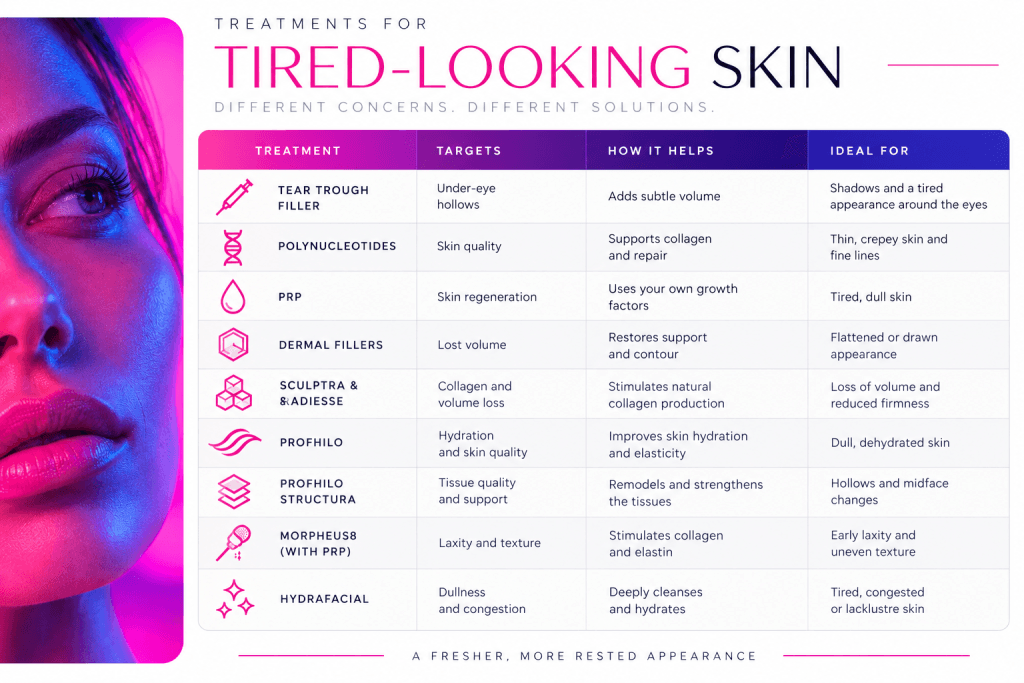
For suitable patients, tear trough filler can be used to soften the hollow and create a smoother transition between the lower eyelid and cheek. FACEMED uses Teosyal Redensity II, a hyaluronic acid-based filler formulated for this delicate area.
There are also many tired-looking eyes where volume is not the main issue. Thin, finely lined or crepey skin can create a fatigued appearance even when there is little true hollowing.
Polynucleotides may be considered when improving the quality of this delicate skin is the priority. Rather than acting as a conventional filler, they support regenerative activity within the skin, including collagen and elastin production.
PRP offers another regenerative approach. A small sample of the patient’s own blood is processed to separate the platelet-rich plasma before it is reintroduced into the treatment area, where it is used to support tissue repair, collagen production and skin regeneration.
Can Loss of Facial Volume Make You Look Tired?
The eyes often receive most of the attention, but changes elsewhere in the face can have just as much influence on a tired appearance.
Facial ageing does not happen only at the surface of the skin. Changes also take place in the fat compartments and deeper supporting structures. As the cheeks or temples lose some of their fullness, the contours of the face can become flatter and shadows may become more pronounced. This can produce a slightly drawn appearance even when someone feels well and their skin is in good condition.
Dermal fillers can be used selectively where restoring lost volume or support is appropriate. The aim is not to make the face fuller everywhere, but to identify whether a particular area has lost enough support to affect the overall facial balance.
Profhilo Structura is another option for age-related changes in tissue quality, facial hollows and midface fat loss. Unlike conventional dermal filler, it is intended to remodel and support the tissues rather than simply adding volume.
Can Dehydrated or Dull Skin Make My Face Look More Tired?
A tired appearance does not always come from changes beneath the skin. Sometimes the skin surface itself is enough to make the face look less fresh. Healthy, well-hydrated skin reflects light more evenly. When the surface becomes dry, rough or uneven, it can appear flatter and duller. Fine dehydration lines may also become more visible, particularly around the eyes.
For milder cases, improving skin condition may therefore be a more logical starting point than altering facial volume.
Hydrafacial works primarily at the skin surface, combining cleansing, exfoliation, a gentle peel, extraction and hydration. FACEMED’s Platinum Hydrafacial also incorporates serums and LED light therapy. It can be useful when congestion, dehydration and dullness are contributing to a lack of brightness.
Profhilo approaches skin quality differently. It is a hyaluronic acid injectable designed to improve hydration and the condition of the skin rather than create facial volume. It may be considered when dehydration is accompanied by fine lines or early changes in skin laxity.
What Happens to Collagen When the Face Starts to Look Less Firm?
Collagen and elastin provide important structural support within the skin. As their production and organisation change with age, the skin can gradually become thinner, less elastic and less resilient. This does not always appear as obvious sagging. Earlier changes can be much subtler, such as fine lines becoming more visible, the skin feeling less firm or facial contours appearing slightly less defined.
Morpheus8 combines microneedling with radiofrequency energy to create controlled micro-injuries while delivering energy at selected depths. This stimulates a healing response and encourages collagen and elastin production.
It is therefore more relevant when skin laxity, texture and declining firmness are contributing to the tired appearance than when the problem is primarily a loss of facial volume.
At FACEMED, Morpheus8 treatment also includes PRP, combining radiofrequency microneedling with regenerative support within the same treatment approach.
Can Treatments Be Combined for a More Refreshed Appearance?
They can, particularly because facial ageing rarely affects only one layer.
For example, dermal filler may be used to address a genuine loss of structural support while Profhilo or polynucleotides address aspects of skin quality. Where facial volume remains relatively good but laxity and texture have become more noticeable, Morpheus8 with PRP may make more sense.
Treatment does not necessarily need to happen at the same appointment. Staging procedures can be useful because correcting the dominant concern first allows the face to be reassessed before deciding whether another treatment would add anything meaningful.
The purpose of combining treatments is therefore not to treat more. It is to use different approaches only when there are genuinely different problems to address.
Frequently Asked Questions
At What Age Does the Face Start to Look More Tired?
There is no particular age. Genetics, facial structure, sun exposure, weight changes and the natural ageing process all influence when changes become noticeable. Some people have prominent under-eye hollows when they are younger, while others notice a tired appearance later as facial volume, collagen and skin quality change.
Why Do I Look More Tired in Photographs Than in the Mirror?
Lighting can exaggerate facial hollows and shadows, particularly beneath the eyes and around the temples. Overhead lighting tends to increase the contrast between prominent and recessed areas, while photographs can make three-dimensional facial contours appear flatter.
Can Skincare Completely Correct a Tired-Looking Face?
Skincare can make an important contribution to hydration, texture, pigmentation and general skin health. However, topical products cannot replace significant lost facial volume or correct structural hollowing. The role of skincare therefore depends on what is causing the tired appearance in the first place.
Can Stress Make Your Face Look Tired?
Stress can coincide with changes in sleep, hydration, skincare habits and general wellbeing, all of which may affect how the skin looks. However, a persistent hollow, loss of facial volume or skin laxity is unlikely to be explained by stress alone.
Looking Less Tired Without Looking Over-Treated
A persistently tired appearance can come from the under-eyes, facial volume, skin quality, collagen loss or a combination of these factors. Understanding the difference is what allows treatment to be planned appropriately.
At FACEMED in Crays Hill, Billericay, we assess facial structure and skin quality before recommending treatment, with the aim of identifying which changes are contributing most rather than applying the same approach to every patient.
We welcome patients from Billericay and surrounding areas across Essex. If you would like to understand what may be contributing to your tired appearance, you can book a consultation for a personalised assessment.